AI Photo - Image Generator
- 4.3
- Rating
- 1.00M
- Installs
- Free
- Price
 Analysis by App-foxy
AI Photo - Image Generator is the kind of app I would open when I have an idea in my head but no drawing skills to express it. It belongs to the art and design category, and its purpose is straightforward: turn a written idea into an AI-created image. I spent time looking at it as a practical creative tool rather than treating it like a magic button, and my opinion is fairly balanced. It can be useful for quick visual experiments, personal projects, and inspiration, but it is not a complete replacement for a proper editor or a human illustrator.
The app is free, carries an Everyone content rating, and comes from MLC Development. Its store presence is already fairly substantial, with more than a million installs and an average rating of 3.5 from roughly 3.2 thousand ratings. Those figures suggest that people are curious about the concept, while the middle-of-the-road score also hints that the experience may not satisfy every type of user. That is important here: AI Photo - Image Generator works best when you treat it as an idea generator, not as a guaranteed image-making machine.
What to decide before relying on an AI image app
Before using any image generator, I think about the job I actually need it to do. If I want a quick mood image for a personal project, the main question is whether the app lets me reach a usable result without making the process feel like work. If I need a polished brand image, accurate lettering, a particular person, or precise control over composition, the standard is much higher.
You May Also Like

 Blood Strike: 2.5 Anniversary
Blood Strike’s Loadouts Turn Every Drop Into a Tactical Gamble
A close look at Blood Strike’s custom loadouts: how fast access to signature weapons reshapes its battle royale rhythm, rewards preparation, and narrows the gap between fights.

 Pandora - Music & Podcasts
Pandora’s Music Is Easy to Start, but Harder to Recover
Pandora’s strength is its low-effort path from a seed to a station. Its weak spot is how much confidence it asks you to place in connection, setup, and quiet recovery.

 8 Ball Pool
 Is Built on Rivalries, Rematches, and Routine
A close look at the rivalries, rematches, shared routines, and unanswered safety questions that turn a quick pool match into a persistent mobile community.

 Samsung Music
’s Quiet Strength Is Playing What You Already Own
Its reach comes less from spectacle than from dependable access to a personal library. That simplicity is both the app’s strongest retention engine and its ceiling.

 AccuWeather: Weather Radar
AccuWeather Review: A Quick, Clear Forecast for Everyday Decisions
For everyday plans, the best forecast is the one you can understand quickly. AccuWeather makes rain timing, radar, and local conditions easy to act on, with a few trade-offs.

 Hill Climb Racing
Why Hill Climb Racing Still Turns Crashes Into One More Run
A tiny car, a bumpy hill and one more upgrade: Hill Climb Racing keeps resurfacing because its simple chaos makes every near-miss feel personal.
More From Our News Desk



That distinction matters with this app because the short store description, “AI Photo,” sets a very broad expectation. In practice, a broad tool can be enjoyable precisely because it leaves room for experimentation, but it can also feel limited when the request becomes technical. I would judge each result on four points: whether the subject is recognizable, whether the style matches the intention, whether small details look believable, and whether the image is useful outside the app.
I also consider how much patience I have. AI image generation is rarely a one-try process. A vague request can produce something attractive but unrelated to what I imagined, while an overly long request can bury the important idea. My best approach is to begin with one subject, one setting, and one visual direction. Once the result is close, I refine only one part at a time instead of rewriting everything.
Writing requests that produce more useful images
For a simple example, I would not begin with “make a beautiful picture.” That gives the generator almost no creative boundaries. I would try something more focused, such as a quiet reading corner beside a rainy window, warm indoor light, soft colors, and a cozy editorial-photo mood. The point is not to use complicated vocabulary. The point is to describe the parts that matter to me.
I found that separating the subject from the atmosphere makes a request easier to improve. First I decide what must appear. Then I add the location, lighting, color feeling, and general style. If the image becomes too busy, I remove details rather than adding more. This workflow is particularly useful for social posts, invitation concepts, phone wallpapers, and early design sketches where the image only needs to communicate an idea.
One less obvious use is creating a small set of visual directions before starting a project. Instead of asking for a final illustration, I can generate several different moods for the same concept: calm, dramatic, playful, or minimal. This helps me make a design decision early, before spending time editing the wrong image. The trade-off is that the results may be visually interesting without being consistent enough to form a finished collection.
Where the app feels most convenient
The strongest part of this experience is the low barrier to trying an idea. I do not need to open a desktop editor, search through stock-photo libraries, or learn a complex drawing interface before seeing a visual direction. For a person who wants to explore an idea during a short break, that simplicity is valuable.
I can imagine using it in an everyday situation such as preparing a small birthday invitation. I might want a gentle illustration of a table with flowers, candles, and soft evening light. The first generated image could help me decide whether the invitation should feel elegant, cheerful, or handmade. Even if I later recreate the design elsewhere, the generated image gives me a starting point instead of a blank page.
It can also help students and hobbyists who need reference material. Someone planning a painting may use a generated scene to explore color relationships. A writer may create a visual prompt for a fictional setting. A small business owner may test the general mood of a social post before asking a designer to make the final artwork. In each case, the value is speed and exploration rather than guaranteed precision.
Another useful habit is to save the wording that produced a promising result. If I only remember the final image and not the description that led to it, repeating the same style becomes difficult. Keeping a short note of the subject, lighting, and mood lets me make related experiments later. This is a practical workaround for anyone trying to build a consistent visual direction with a tool that is primarily designed for individual generations.
Where the results need a careful eye
AI-generated images can look convincing at first glance while still containing details that do not hold up. I pay particular attention to hands, small objects, facial features, jewelry, repeated patterns, and any writing inside the image. These areas are easy to overlook when viewing a picture as a thumbnail, so I inspect the result at a larger size before deciding that it is ready to share.
Text is a special problem for this type of tool. If I need a poster, logo, menu, or invitation with readable wording, I would not depend on the generated image to handle the typography perfectly. I would use the image as a background or illustration and add the actual text in a separate design app. That extra step is not a failure of the concept; it is simply a sensible division of labor between image generation and layout.
People who need the same character in several scenes should also be cautious. A generator may create attractive individual images without maintaining every visual identity detail from one request to the next. For a personal mood board, that may be acceptable. For a comic, product campaign, or illustrated story, inconsistency can quickly become the main problem.
I would also avoid treating a generated image as automatically accurate. If I ask for a historical object, a technical diagram, a medical illustration, or a recognizable location, I would verify the important details independently. The app can suggest a visual concept, but it should not be my only source when accuracy has consequences.
How it compares with the usual alternatives
The most obvious alternative is a traditional photo editor. An editor is better when I already have an image and need to crop it, correct colors, remove distractions, arrange layers, or add exact text. AI Photo - Image Generator is better at producing a starting point from an idea. These are different jobs, so choosing between them depends on whether I am creating from nothing or refining something I already have.
Stock-photo services are another category. They usually make more sense when I need a realistic image of a common subject and want a result that looks deliberately photographed. This app is more appealing when the scene is unusual, stylized, or difficult to find in a stock library. The downside is that a stock image may offer more predictable composition and realism, while an AI result may require inspection and cleanup.
Drawing and illustration apps remain the better choice for direct control. If I need to place every line myself, preserve a personal style, or make a precise revision, a canvas-based tool gives me control that generation cannot replace. I would use this app before that stage for references and rough concepts, then move to a drawing app once the direction is clear.
There is also a difference between a broad image generator and a specialized design platform. A specialized platform may be more suitable for templates, brand assets, social layouts, or text-heavy work. AI Photo - Image Generator makes more sense when the central need is an image idea rather than a complete finished composition. I would not choose it as my only tool for a full marketing workflow.
Practical limits and the cost of switching tools
The app’s free price makes experimentation easy, but “free” does not remove the cost of time. If I need several attempts to get a useful composition, then reviewing, saving, and possibly editing those attempts becomes part of the real workflow. For casual use, that is a fair exchange. For repeated professional work, the time spent correcting results may outweigh the convenience of generating them.
Switching to another category of tool also has a learning cost. A traditional editor asks me to understand selections, layers, masks, and export settings. A drawing app asks for comfort with brushes and composition. A stock library asks me to search carefully and usually adapt my design to the image I find. This app reduces the technical entry point, but it shifts some of the work into describing the idea and judging the output.
My advice is to decide where the app sits in the workflow before committing to it. If it is used for brainstorming, it can save time and reduce creative hesitation. If it is expected to deliver final artwork for every situation, frustration is more likely. I would keep a conventional editor available for finishing touches, especially when the image needs readable text, exact dimensions, or a clean visual hierarchy.
The current version is 1.0.5, and the app was released on January 8, 2026. It supports devices running Android 7.0 or later, which makes it accessible to people using older Android hardware. That broad compatibility is convenient, although the experience of any image-generation app can still depend on the phone, connection quality, and how demanding the requested image is. I would leave enough storage and patience for a workflow that may involve trying more than one idea.
Who should use it and who should skip it
I would recommend it to casual creators, students, hobby artists, writers, and anyone who wants to turn a rough visual thought into something visible quickly. It is especially suitable for brainstorming, personal wallpapers, mood boards, concept references, and simple social content where the image does not need to carry exact information.
I would be more hesitant to recommend it as the main tool for a professional designer who needs repeatable brand consistency, production-ready typography, accurate product presentation, or detailed control over every element. That person may get value from it during the early concept stage, but a specialized editor, illustration program, or stock source will usually be the stronger finishing environment.
Parents and younger users may appreciate the Everyone rating, but I would still encourage sensible supervision when children are experimenting with prompts. The rating makes the app broadly accessible; it does not mean every imaginative request will automatically produce an image suitable for every context. A quick review before sharing is a good habit for anyone.
My recommendation after using it as a decision tool
My final view is positive, with clear boundaries. AI Photo - Image Generator is worth trying if I want a free, approachable way to explore visual ideas without learning a full design program first. Its best role is the first step: turning a sentence into a direction, a mood, or a rough visual reference that I can evaluate and improve.
I would not choose it when precision is the priority. For exact lettering, consistent characters, detailed technical subjects, or polished commercial artwork, I would move to a different tool sooner rather than later. The app becomes much more useful when I stop asking it to replace every other creative program and instead use it for the part it handles most naturally: opening up possibilities.
With an average rating of 3.5 and a growing audience, it sits in a middle ground rather than presenting itself as a flawless solution. That feels fair to me. The developer, MLC Development, has made an accessible art and design app for quick image experiments, and the free entry point lowers the risk of testing it yourself. My recommendation is to install it for brainstorming and visual exploration, then keep a proper editor nearby for anything that must be exact.
FAQs for AI Photo - Image Generator
01What is AI Photo - Image Generator?
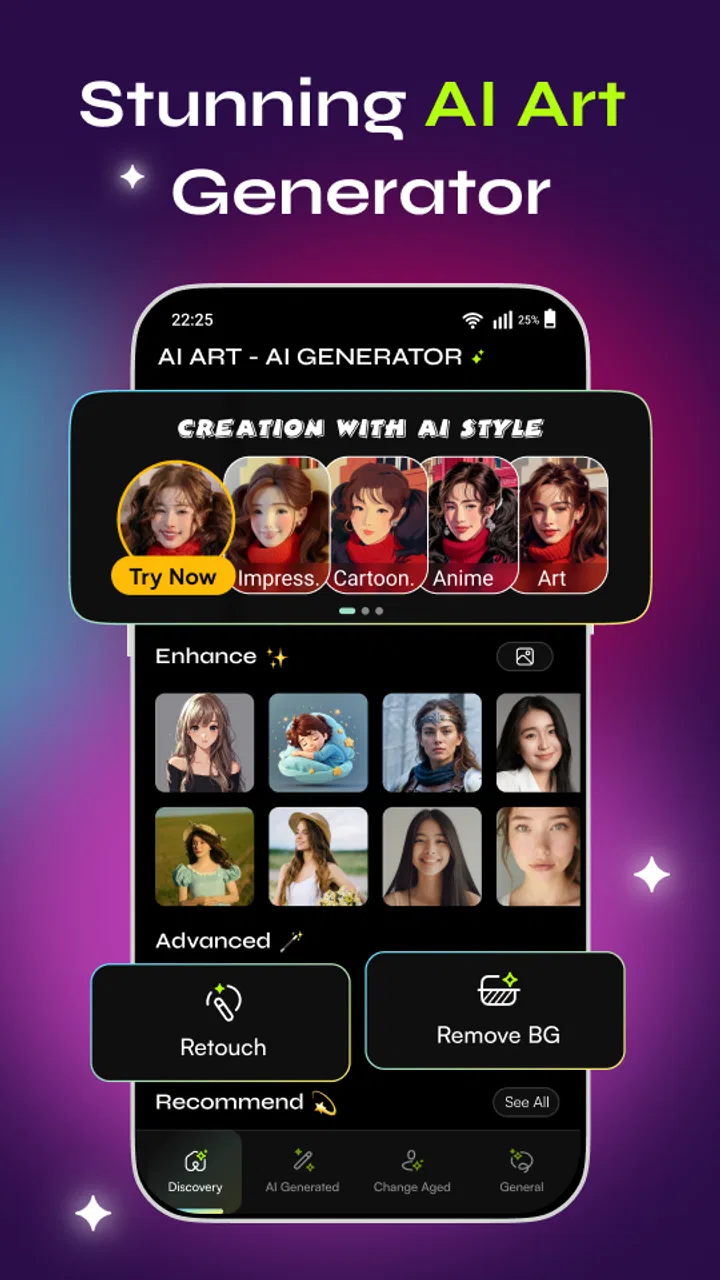
AI Photo - Image Generator is an innovative app designed to create stunning images using artificial intelligence. It leverages advanced algorithms to transform simple inputs into artistic visuals. Users can create unique images with various styles and effects, making it a powerful tool for both casual users and professional designers.
02How does AI Photo - Image Generator work?
The app works by utilizing AI-driven technology to analyze user inputs and generate images based on preset styles and effects. Users can input text or upload images, and the AI processes this data to create visually appealing results. The app also allows for customization, enabling users to tweak the output to their liking.
03What platforms is AI Photo - Image Generator available on?
AI Photo - Image Generator is available on both Android and iOS platforms. Users can download it from Google Play Store for Android devices and the Apple App Store for iOS devices. The app is designed to be user-friendly, with a consistent interface across different operating systems.
04What are the main features of AI Photo - Image Generator?
The app offers a range of features including AI-driven image creation, style presets, and customization options. Users can apply filters, adjust colors, and modify the texture of generated images. Additionally, the app supports high-resolution outputs, making it suitable for professional and personal use.
05Is AI Photo - Image Generator free to use?
AI Photo - Image Generator offers both free and premium versions. The free version provides basic functionality with limited features, while the premium version unlocks advanced tools and additional styles. Users can choose the version that best fits their needs, with the option to upgrade at any time.
Pros
- Easy-to-use interface for beginners.
- Generates high-quality images quickly.
- Wide variety of style options.
- Regular updates with new features.
- No watermarks on exported images.
Cons
- Limited free version capabilities.
- Requires a stable internet connection.
- Occasional lag in processing images.
- Subscription model can be pricey.
- Some styles lack customization.

AI Photo - Image Generator
Gallery